
Social media is undoubtedly one of the most applicable use cases for Web3.
From increased data ownership, to enhanced security, to converting free users into revenue, Web3 can bring a host of benefits to social networks that traditional Web2 does not.
However, no one has truly found product-market fit and established a dominant position in the industry. This article aims to break down the different arguments surrounding the case for decentralized social and assess whether or not today’s users are finally ready to embrace this inevitable paradigm shift.
The Web3 Social Stack
A report from Coinbase divides the decentralized social landscape into four layers: hosting, social primitives, profile, and applications.

While many of the companies on this map may be familiar, this piece will focus more specifically on the social primitive layer.
Social primitives represent the foundational blocks upon which individuals and their identities are represented. A subsection within this layer is social graph protocols, which are decentralized databases that store information about individuals and their relationships with each other.
Some examples of social graph protocols include
A decentralized social network in the form of an open protocol that can support different clients, such as email.
Leveraging Ethereum for decentralized identity, users can freely move their social identities between the different applications, while developers can continue to build new and competing applications on the network.
For example, users can jump between apps such as Searchcaster (search for anything on the Farcaster protocol with APIs or a GUI), Launchcaster (platform to discover the best new Web3 projects) and Frens (a messaging app for Web3 explorers).
| Year Founded | 2021 |
| Headquarters | Los Angeles, California |
| Employees | 4 |
| Funding Stage | Seed |
| Funding | $30M |
A decentralized social media platform built by Aave Companies in the form of an open protocol that is designed to be interoperable, allowing creators to build their own custom social media experiences.
Developers can also easily build social applications with the Lens SDK. Lens remains in beta with over 100,000 users.
| Year Founded | 2017 |
| Headquarters | Cayman Islands |
| Employees | 102 |
| Funding Stage | Seed |
| Funding | $15M |
DeSo is the first Layer-1 blockchain built from the ground up to decentralize social media and scale storage-heavy, but developer-friendly applications to billions of users.
Its open-source and permissionless design mean that all posts and social graphs on DeSo are stored directly on-chain.
| Year Founded | 2019 |
| Headquarters | Los Altos, California |
| Employees | 21 |
| Funding Stage | Seed |
| Funding | $200M |
What Can’t Web 2.0 Provide?
As of the end of 2023, an estimated 4.9 billion people use some form of social media across the world, and the average user spreads their digital footprint across six to seven platforms.
However, all these user interactions happen in a closed ecosystem where tech giants such as Meta fully own users’ identity and data.
Due to this monopolistic environment created by traditional Web2 platforms, there are high barriers of entry for new competitors, as well as high switching costs for users generated by network effects.
Most recently, Meta introduced their ‘Twitter Killer’ app – Threads. The launch of the app received a lot of attention, as the platform hit 100 million sign-ups in less than five days.
However, the platform failed to retain its stickiness, and saw its daily active users halve. This could be due to the fact that Threads does not offer all the features that Twitter does, but also because Twitter has established a strong and loyal user base.
In an age where we are spending a significant amount interacting online, Web3 has the potential to return data ownership and control to users.
Data Privacy
One of the foremost monetization strategies of Web2 social giants is selling user data to third parties such as advertisers.
With such financial incentives, user privacy is often compromised, decreasing the overall user experience. Advertising is not completely washed away in Web3, one of our portfolio companies, Persona, is a Web3 advertising platform that leverages the power of on-chain data for precise targeting.

Advertisers can improve ads ROI by 200%, while users have the opportunity to participate in revenue sharing while ensuring that their data and privacy is protected.
Overall, Persona brings value to different stakeholders across the ecosystem, enhancing the overall user and developer experience.
On the contrary, decentralized social takes the opposite approach. Decentralization means that user data is distributed across a wide network of computers, rendering it impossible for one centralized entity to access or control it.
Thus, users have complete control over their own personal data, and privacy and security does not have to be compromised.
For example, Polygon launched Polygon ID, which leverages zero-knowledge (zk technology) to grant users with a self-sovereign, decentralized and private identity for the ultimate user privacy. Users will be able to access apps anonymously, and protocols do not need to rely on a middle man to execute interactions with users.
Data Ownership
Decentralized social also fulfills one of the main objectives of Web3, to return complete data ownership to the user.
Since a decentralized social graph is stored across numerous blockchain nodes, users have the right to decide what they want to do with their personal data. They can choose what (not) to share, and even monetize it by directly selling to third parties.
Given complete data ownership, users will be able to reshape their social networking experience based on their own preferences and interests, without having to rely on centralized entities for ad-based curation.
Content Monetization
Although different social graph protocols are taking somewhat different approaches to transform the decentralized social landscape, they are all enabling users to own the direct relationship with their audience.
This allows users to create their own monetization opportunities, whether that be through selling data to third parties, or content creation, users can now be economically empowered online. With economic incentives aligned between the platform and the user, Web3 platforms can benefit by easily converting users into revenue, which is something that Web2 has historically struggled with.
Take Lens Protocol’s approach as an example. Each piece of content (whether that be song, video, or artwork) on the protocol is a non-fungible token (NFT), granting content creators full ownership rights to their data.
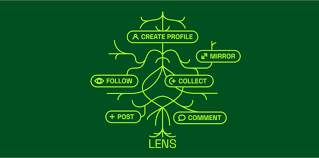
The modular design of the platform means that new features are constantly added to the platform, while still maintaining immutable user-owned content and social relationships.
Since these different permissionless and composable social graph protocols are not standalone networks, developers are free to build their own different clients, or apps, across the protocol. Users can then take their own identity, for example, Farcaster leverages Ethereum to generate a wallet address that is mapped to a username and interact with different apps as they like.
With this flexibility, users can now more accurately tailor their content towards specific target audiences to maximize revenue and monetization opportunities.
But users are not the only party that can gain from decentralization. The underlying protocol, as well as the developers that choose to build on top of it, benefit as well.
For instance, transaction fees are generated on the different apps on top of a social network, which would be equitably split among the user, app developer, and the protocol. Since the open-source nature of these protocols promote competition amongst developers, apps may even begin charging subscription fees to grant access.
This model was coined by DeSo as the ‘Blockchain Business Model’. Essentially, the argument here is that blockchains have enabled tipping, microtransactions, and micro-subscriptions, which the traditional financial system has failed to accommodate.
Therefore, storing content on a public blockchain and keeping it ‘open’ results in more people building apps on a given network, resulting in more transactions and fees.
Ultimately, a single killer app that encompasses all the features mentioned above and empowers both the user and app developer will have the potential to disrupt traditional media as we know it today.
Decentralized Search Algorithms
Although Web3 facilitates a brand new way to monetize social content, users won’t care about decentralization, trustlessness, permissionless-ness, and anti-censorship if the user experience is bad.
One of the key value drivers of Web2 social are the algorithms, as they provide tailored feeds based on a user’s preferences and consumption habits.
However, since traditional algorithms rely on centralized systems, the value captured from data insights has to first flow through the intermediary social network before it reaches the user or creator.
For example, currently, no truly decentralized solution exists for the algorithmic method of content distribution. Steps are being taken in the decentralized search space to achieve this. Decentralized search is an approach that distributes the search process across multiple nodes instead of relying on a central server. Each node in the network contributes its resources and knowledge to perform the search.
Decentralized search outperforms traditional search in four key areas:
- Scalability: As search is distributed across multiple nodes, the network will be able to accommodate an ever-growing number of users to ensure scalability;
- Increased Response Times: Localized search operations minimizes the latency introduced by transmitting queries and results across the network, resulting in an overall improved user experience;
- Enhanced Privacy: One of the biggest benefits to the user is that decentralized search minimizes the exposure of user data to a single central server, limiting the risk of data breaches;
Increased Fault Tolerance: Distributed node networks mean that search can still continue even if some nodes become faulty or unavailable.
As developers continue to understand the space, decentralized search algorithms will complement and enhance decentralized social networks, providing an unparalleled user experience without compromising privacy or ownership.
Challenges
If executed properly, decentralized social is set to transform the way we interact with the Internet. However, there are still some major hurdles that have to be overcome before mass adoption can be achieved.
As the landscape becomes increasingly saturated, traditional Web2 users might struggle with choosing a platform they resonate with the most.
If proper network effects are not established, users might be hesitant to leave current dominant Web2 players. Decentralized social networks are also inherently more complex, a lack of a user-friendly platform will also deter non-tech savvy users from joining these platforms.
There are also other issues that come with blockchain-native networks. For example, apps or features built upon crypto economies for rewards systems might be subject to market fluctuations and volatility.
In order to increase the stickiness of the platform for both developers and content creators, platforms might need to find an alternative solution to increase the overall stability of the network.
Although it still remains to be seen, platforms may run into regulatory issues as governments and financial institutions seek a global standard for blockchain.
Key Insights
There is no single network or ‘killer app’ that has emerged in the decentralized social landscape.
However, as the benefits of decentralized networks become increasingly clear, a network that can both economically empower users and developers will catalyze a shift in behavior.
Ribbon, one of our portfolio companies, is building a modern professional network by taking public professional data on-chain. Ribbon is attempting to rebuild the world of professional social networks and employee recognition to be centered around one thing – ownership.

At Cadenza, we are actively evaluating decentralized social opportunities to identify the next big social network that will rival the likes of Facebook, X, and Instagram.
If you found this informative, you may also like Web3 Gaming is Going Mainstream and Thoughts on Generative AI.
If you would like more information on our thesis surrounding Decentralized Social Media or other transformative technologies, please email info@cadenza.vc
 Cadenza Chronicle