
A lot has changed since the beginning of the 21st century, smartphones are now commonplace, movies and music are primarily streamed online, and cars don’t run solely on gas anymore.
However, one thing hasn’t changed much – search engines…until now.
From Hyperlinks to Keyword-based Search
Before Google began indexing the web as early as 1996, search was limited at best and non-existent at worst.
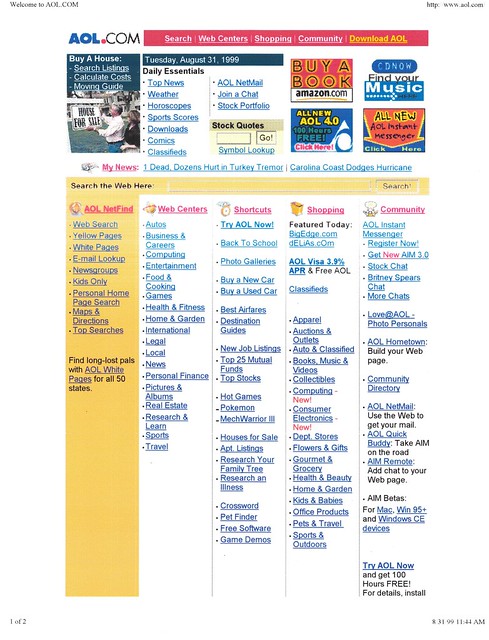
In order to find anything that you were looking for, such as fitness tutorials for example, you had to visit one of the major web portals at the time, like AOL.com, Excite or others and manually scroll through scores of hyperlinks to third-party websites organized by category.
To make matters worse, you were highly likely to be flooded with a slew of graphic banner ads and pop-ups as you navigated your way through this digital maze. Fun times.
Google’s simple, uncluttered design and contextual ads saved us from this mess and most importantly, its search results were simply more relevant and better.
Nearly everyone agreed and ” to Google” something became a verb, while the search engine’s market share grew to a majority of the nascent market.
Two Decades of Dominance
This is by and large where things still stand today.
Google’s PageRank algorithm continues to provide the foundation for the search results it produces and it retains an overwhelming majority of the search engine market.
However, things have recently begun to change.
Google has consistently been losing U.S. search market share since August 2023 and there are several reasons why.
AI is Transforming Search
Similar to how search evolved from hyperlinks to being keyword-based in the early 2000s, search is now undergoing its biggest change in more than two decades.
We have now entered the era of natural language queries thanks to artificial intelligence.
As an example, which would you rather do:
A) Type a keyword or two about a subject you’re interested in into a search box and receive pages upon pages of contextual ads and search results back, which you also need to spend time sifting through to find what’s most relevant or
B) Ask a basic question, like you would a knowledgeable friend, and instantly get a reply back in less than a second.
If you’re like us, you would probably choose the more expediant option, which is now possible thanks to “conversational search engines” such as Perplexity AI.
Launched in beta mode in 2022, Perplexity’s name contrasts its simplicity and aim, which is to “provide trusted answers to any question.”
If we take a peek under the hood of Perplexity, we will see that machine learning models are the engine that make it go. These have several distinguishing features that set them apart from traditional search algorithms:
- ML models continuously learn and adapt
- They provide personalized answers and results for each user
- Are capable of complimentary features such as summaries and visuals
The last point is especially important and a big reason why search traffic is down, as the next generation clearly prefers visual platforms over text-based ones.
Coincidentally, the rise of popular visual social media platforms, such as TikTok, are also among the reasons why traditional search engine results have deteriorated.
Back when Google’s PageRank was first conceived in the 90s, social media wasn’t yet a thing and very few people had their own web pages, which made ranking sites based on backlinks, among other factors, a much simpler task.
Today, anyone can create a social media profile in less than five minutes which links out to a website, which in turn affects that site’s search ranking.
Bottom line, it has become easier than ever to manipulate search algorithms.
Giving Power Back To The User
New entrants into the search market, like Cadenza-backed Kagi, are attempting to counter this by offering a “premium” search engine.

This means no ads, user privacy, and more accurate search results…for a small fee.
In its manifesto – The Age of PageRank is Over, the company highlights the inherent bias of ad-funded search engines towards advertisers and away from users.
Its an obvious conflict of interest, but like all businesses, search engines still need to pay the bills and keep the lights on for their extended family of executives, employees, and shareholders.
For just $5 per month on a starter plan, your privacy and data are protected and you get conflict-of-interest-free search results based solely on your intent, instead of advertiser dollars.
But this is far from all it offers.
Because it is user-supported, Kagi’s personalization options put the power back at your fingertips.
Every search result features a shield icon on the right-hand side. Hovering over this icon or clicking on it gives you the option to adjust that website’s ranking in your search results, moving it higher, lower, or removing it completely. Its all up to you.
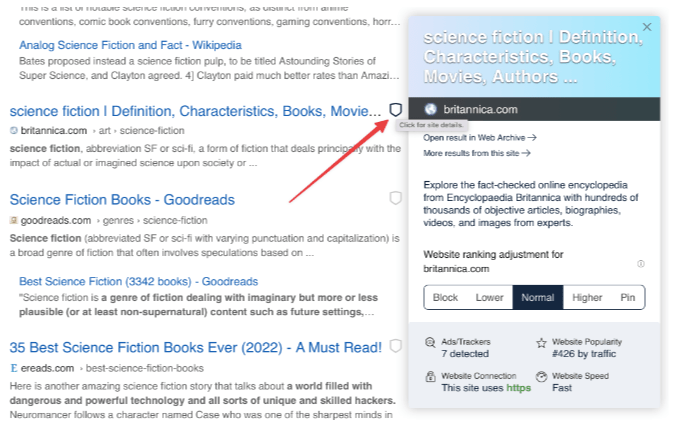
There is even a Personalization Leaderboard, which anonymously aggregates the rankings of domains that have been tagged by other Kagi users.
When it comes to AI integration, Kagi doesn’t disappoint.
The emerging search engine offers a full generative AI research assistant that taps into Kagi search, a large language model (LLM), and third-party sources to answer queries.
Although this feature is currently only available to Ultimate Plan members, another that is wholly unique to Kagi is available to all users.
This is the ability to summarize any page appearing in search results.
So instead of a regular search results page like this:

You get a ready-to-read digest like this:
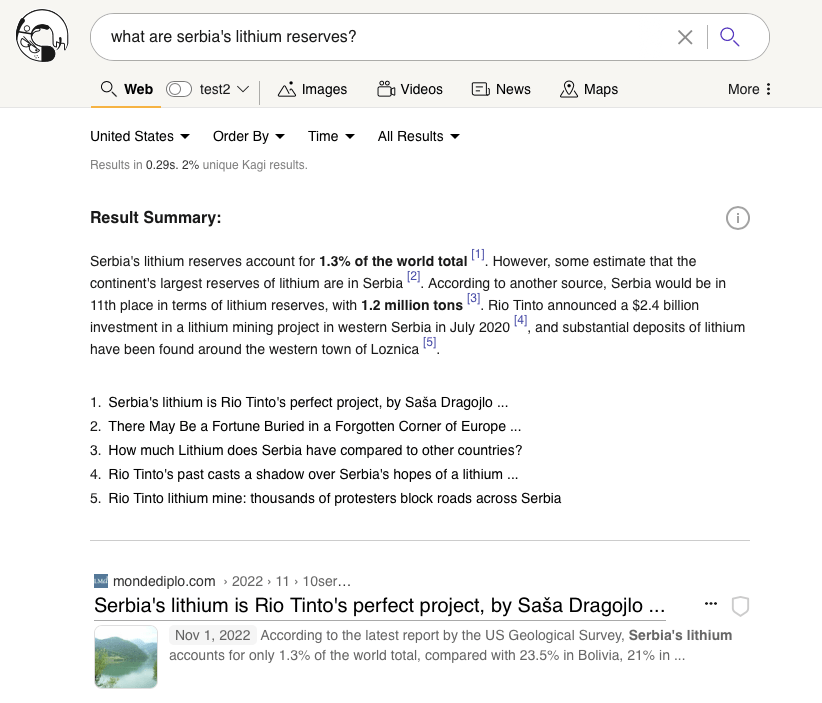
This is possible thanks to Kagi’s Universal Summarizer technology, which true to its name, can summarize almost any kind of web content and it’s available for any search result.
Add-ons are also sprouting up to support the search experience.
For example, Apple users, all 1.5 billion of them, can take advantage of a free, lightning-fast, privacy-protecting browser called Orion.
Orion is still at the beta stage, but some of its early features include a video picture-in-picture mode for macOS, a Reader Mode which de-clutters web pages for reading, and an option to edit the text on page for screenshots, among other features.
Kagi makes a convincing argument for paid search, not only do you get a completely personalized experience, but you also get access to multiple generative AI LLMs, and data privacy.
As we write this, Kagi is a profitable business with more than 20,000 active subscribers and it plans to keep growing organically while keeping its spending low.
What About AI Biases?
As the incumbents in the current search landscape, Google and Microsoft have a huge first-mover advantage.
This advantage comes from the abundance of data they have at their disposal to train their machine learning models on.
Despite this, both Google Bard’s and Microsoft-backed OpenAI’s ChatGPT generative AI models have shown some notorious biases in their query responses.
These have fondly come to be known as AI “hallucinations” and they are a growing problem.
Based on the early info gathered so far, the source of the problem is usually insufficient training data, which will correct itself over time as models absorb more and more data.
But the old computer science term “garbage in, garbage out” is also relevant here.
An AI model, after all, can only be as good as the data used to train it and plenty of public data today is not only inaccurate, but deliberate misinformation.
The Evolution of Search
Natural language queries, visual search, even problems, such as AI hallucinations and compensation models are all part of the ongoing evolution of search.
While AI won’t fully replace the current search experience, it is changing the way we view, interact with, and use data.
Soon, we will even be able to organize existing information in new ways simply by asking a search engine to do it for us.
Just like a sci-fi movie come to life, the only limits will be our imagination.
If you found this informative, you may also like Raising the Bar: How AI Is Transforming the Legal Practice or Guardians of the Galaxy: How AI Is Changing Cybersecurity.
If you would like more information on our thesis surrounding AI in search or other transformative technologies, please email info@cadenza.vc
 Cadenza Chronicle
One response to “AI Is Revolutionizing Search: Why the User Experience And Search Results Will Never Be The Same”
[…] If you found this article insightful, you may also like AI In HR: Transforming The Workplace or AI Is Revolutionizing Search: Why the User Experience And Search Results Will Never Be The Same […]
LikeLike