A more open, autonomous, and safer internet. These are the core values the Telegram Open Network (TON) was founded on in 2018.
However, regulatory challenges and other roadblocks forever changed the trajectory of the project. This is the story of how we got here, what TON is today, and what it could become.
A Temporary Restraining Order
On October 31, 2019, the largest private initial coin offering (ICO) in history was set to take place.
Telegram and it’s TON Issuer Inc. subsidiary had sold a cool $1.7 billion worth of proprietary tokens called Gram (GRM) to an array of private investors, which it would use to support the launch as well as ongoing operating costs of a decentralized app network that would integrate with the popular Telegram messenger app that boasts 900 million monthly users.
Among these investors were 31 U.S. based purchasers, which is where the trouble started.
See, securities sales in the U.S., especially of this size and scope, are highly regulated and fall under the purview of the Securities & Exchange Commission (SEC).
We now know that digital tokens are by and large seen as securities, but this precedent hadn’t been set as yet back in 2019.
So, Telegram proceeded with an unregistered token sale.
This proved to be wishful thinking, as the SEC immediately cried foul in court and swiftly obtained a temporary restraining order against Telegram and TON, seeking “emergency relief,” as well as permanent injunctions, disgorgement with prejudgment interest, and civil penalties.
The SEC’s regulatory action would alter the course of TON forever.
Open Source to the Rescue
Following an eight-month-long legal battle, the SEC settled with Telegram, who agreed to return $1.2 billion of the money it raised back to investors and pay an $18.5 million penalty.
However, that is not all it did.
Telegram officially withdrew from the planned project following the SEC settlement, although its influence on TON continues to this day. This much was evidenced by the token’s volatile price action following last year’s untimely arrest of Telegram co-founder Pavel Durov.
Something else that lived on was Telegram’s original white paper, outlining TON’s principles.
This would become the foundation for its re-birth.
NewTON
Anatoliy Makosov and Kirill Emelyanenko are open-source developers and self-admitted decentralized tech enthusiasts.
A more open, autonomous, and safer internet, like Telegram envisioned spoke to their individual ideals.
Fittingly, the two met while taking part in various Telegram programming contests in their spare time and they were already familiar with developing blockchain applications by the time their paths crossed.
According to Anatoliy, both he and Kirill thought that “TON was extremely promising.“
So when Telegram removed themselves from the project, they saw an opportunity to put their very specific skills to work and bring it back from the dead.
Slowly but surely, a small developer community formed, which would originally go by the name NewTON.
As per Anatoliy, the loosely cobbled group’s initial aims were humble.
They included finding a way to first, get the blockchain off the ground, integrate the newly rechristened Toncoin (formerly Gram) with Telegram, and make the coin relevant.
Besides ensuring the stability and security of the network, the core development team has made the TON blockchain one of the fastest in the world, capable of processing over 100,000 transactions per second due to its unique multi-blockchain architecture.
Without getting overly technical, this architecture has been described as a “blockchain of blockchains“, each capable of operating independently and processing its own transactions, something extremely valuable which we will touch on more a little later on.
This early work would inspire others such as Andrew Rogozov (former Vice President at VK), Julian Tan Yong Kiat (formerly of Binance), and others to get involved with the NewTON project.
These early adopters would help spur it’s rapid expansion.
A Growing Ecosystem
Today, most of the ideas outlined by Telegram co-founder Nikolai Durov in the original TON whitepaper have been implemented, and then some.
Not only is TON a platform on which third-party decentralized applications can be built, but Toncoin can seamlessly be sent as an attachment from the Telegram chat menu.
Not to mention the fact that it now boasts a substantial following, with $400 million worth of coins being traded daily.
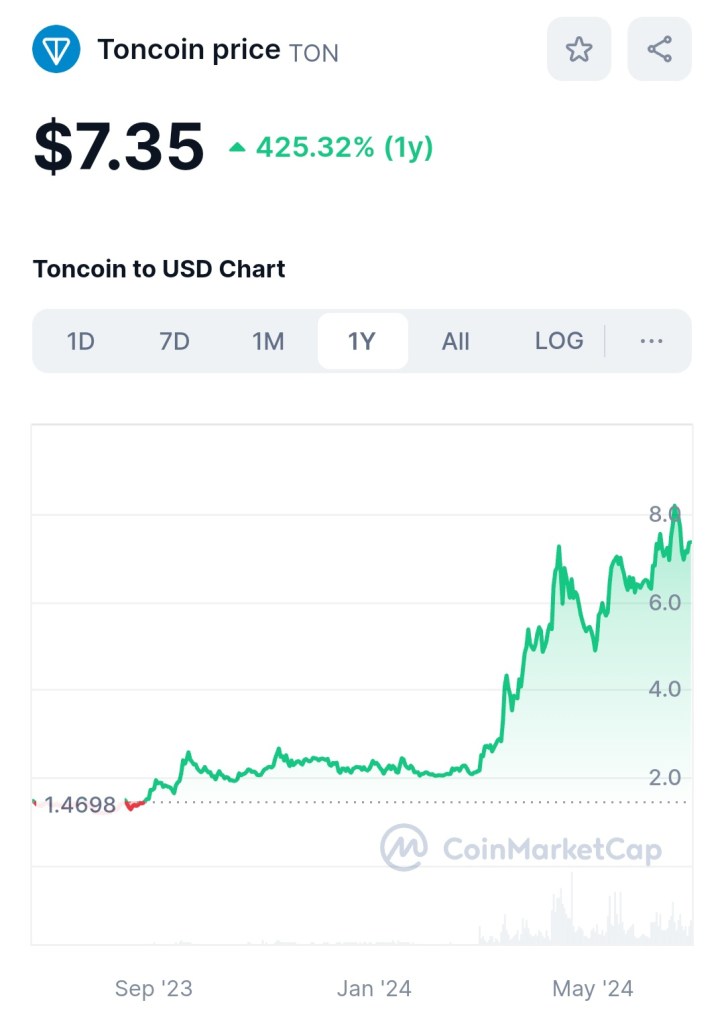
Additionally, it’s code is also continuously audited for vulnerabilities and errors by third parties such as CertiK and Quantstamp, making it secure enough for enterprise use.
What started out as a small side project nearly four years ago, is now a multi-billion-dollar platform and all the running jokes about making Toncoin relevant have given way to speculation about how valuable it can become.
In this respect, the platform’s ability to support the development of decentralized applications, which are growing in popularity by the day, could be its major catalyst.
The TON Foundation
The primary objective of NewTON, now going by the name TON Foundation, is to maintain and develop the network’s growing ecosystem and promote the mass-adoption of decentralized technologies and cryptocurrencies.
An overwhelming majority have heard of the latter – cryptocurrencies, with just over 4% of the world population now owning some form of crypto.
However, far fewer have heard of, let alone, ever used a decentralized application (dApp).
This is about to change and it presents a huge opportunity for TON and for investors in general.
In a blog post, TON’s developers acknowledged that the main challenge of Web3 is to provide real-world use cases.
The same article outlined some of the use cases for how it’s network is beginning to do this and disrupt centuries-old industries in the process.
A Potential Super App
Where could payments, trading, supply chain management, and more potentially all converge?
The answer is on the “Super App” that TON is transforming Telegram into.

Picture near real-time stock trades thanks to the blazing fast speed of TON’s blockchain.
Or an international money transfer that costs pennies on the dollar compared to the hefty fees charged by financial institutions today.
Even immediate settlement of logistical transactions are possible by leveraging TON’s infrastructure…all without having to leave the Telegram app.
It is now making an aggressive push into the U.S. market, with major exchange listings and strategic partnerships to follow.
If developers create enough truly useful decentralized applications on the TON blockchain that provide everyday utility to Telegram’s 900 million monthly users and beyond, then “dApp” is a term you will be hearing a lot more of and it could even creep into the mainstream, much like crypto has.
Like all good things, this will take time, but the TON blockchain’s dependability, speed, and low fees provide a promising foundation.
If you found this insightful, you may also like Guardians of the Galaxy: How AI Is Changing Cybersecurity or Crypto for Everyone: How ETFs Are Taking The Blockchain Mainstream.
If you would like more information on our thesis surrounding Decentralized Applications or other transformative technologies, please email info@cadenza.vc


2 responses to “Regulatory Bans, Decentralized Apps, And Telegram: Exploring the TON Ecosystem”
[…] have raised billions right out of the gate, while others have become market leaders. Others still, were victims of their own […]
LikeLike
[…] If you enjoyed this article, you may also like Charting New Territory: How DePIN is Changing The Physical World With Digital Technology or Regulatory Bans, Decentralized Apps, And Telegram: Exploring the TON Ecosystem. […]
LikeLike