
Artificial intelligence is poised to revolutionize industries and daily life, marking one of the most significant advancements since the internet.
But if its going to have this kind of far-reaching impact, an ecosystem in which AI technologies thrive will first need to be established and several other challenges overcome as well.
We look at what these are and one company trying to democratize access to computational power.
GPU Not CPU
The first thing to understand is that there are four primary types of artificial intelligence:
- Reactive
- Limited memory
- Theory of mind
- Self-aware
The latter two types of highly sophisticated AI are not even possible at this stage due to the lack of hardware and algorithms needed to support them.
However, the former two are a reality today and require something called a processing unit to properly function.
There are two types of processing units:
- Computer processing unit (CPU)
- Graphic processing unit (GPU)
But only one is ideal for high-powered machine learning tasks that AI is built on.
Although CPUs are critical for daily computer tasks, like retrieving, processing, and displaying information on a screen. GPUs are needed to perform quick, complex calculations, like the kind required for machine learning.
So why is this a problem?
Well, its because GPUs are more scarce than a pink diamond and also more expensive than some too.
A next-gen GPU chip can cost as much as $30,000 to $70,000, with a complete server rack costing more than $3 million.
As you can imagine, this high barrier to entry is beginning to stifle AI development and innovation.
All of this is due to a supply/demand imbalance that can be traced back to the fact that the global GPU market is controlled by a single multinational corporation.
The company in question is Nvidia, which currently has a stranglehold on the GPU market with an incredible 88% market share.
But access to GPUs isn’t the only challenge facing the development of AI.
Absence of (Artificial) Intelligence
More than half of all AI professionals have less than six years of experience.
At the same time, there has been a five-fold increase in the demand for such skills since 2015.
This is leading to some in senior roles being ill-equipped to spearhead the implementation of large-scale AI projects.
But its not just a lack of knowledge on the part of leadership that causes a staggering 70-80% of AI projects to fail. From organizational hurdles like not having clear processes in place to technical roadblocks, such as integrating AI into existing legacy systems, the potential pitfalls are numerous.
Another one of these pitfalls is data security.
With AI implementation comes dealing with scores of data. Defining what quality data is, collecting it, using it to build models suited to your specific goals, and constantly improving upon it. It’s all a never-ending process, so it’s no wonder that many are turning to third-party vendors, not only to access AI tools, but also to help create an ecosystem in which they thrive.
One business is at the forefront of addressing such challenges and democratizing access to AI.
Removing Barriers to Access And Innovation
When serial entrepreneur Darrick Horton was asked in an interview what inspired him to start his latest business, he said:
“I believe that monopolies should not exist.”
This is the premise on which cutting-edge AI cloud platform TensorWave was founded.
An engineer by trade, Darrick worked on NASA-funded plasma physics research and nuclear fusion projects before beginning his entrepreneurial journey.
This included founding or co-founding several startups focused on data centers, cloud infrastructure, and semiconductor technology. These provided him with the necessary experience for his most transformative opportunity ever – harnessing the power of AI.
Seeing how Nvidia’s dominance of the GPU market was creating barriers to access, Darrick sought to remove such roadblocks for himself and others.
Making AI Available To All
One way TensorWave does this, is by offering immediate and affordable access to alternative chip solutions.
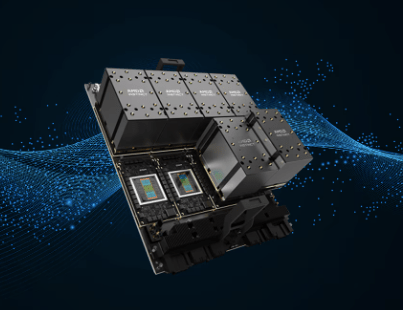
This includes AMD’s MI300X.
Designed specifically for training and fine-tuning AI workloads, it stacks up favorably against Nvidia’s current-gen H100 GPU chip:
- 2.4x more memory capacity
- 2.4x more calculations per second
- 1.3x more streaming processors
So, not only does TensorWave make it easier and cheaper to access GPUs on demand, but it also provides enhanced performance.
However, the AI cloud platform’s benefits only begin here.
Scaling Securely
We highlighted earlier how 70-80% of all enterprise AI projects to fail.
TensorWave goes the extra mile to make sure this doesn’t happen, by ensuring that once you have access to the necessary AI hardware, you also get the most out of it.
It does so by optimizing your data for its hardware and by making sure all compute tasks are fine tuned for performance. But that’s not all.
White glove, hands-on assistance is also available to onboard or migrate over from other platforms, so AI implementation experience or a lack thereof is no problem.
After this initial step, the heart of TensorWave’s platform, TensorNODE, takes over.
Between offering a full AI hardware stack to long context support for large-scale data analysis and natural language processing, the platform enhances productivity and has the ability to scale up as needed with a projected 20,000 accelerators deployed across two US-based facilities by the end of the year.
The cherry on top is TensorNode’s security infrastructure, with access to the platform only available to devices physically connected to the network, much like an Ethernet connection.
Similar to nature, an AI ecosystem requires cooperation to create a balanced, thriving environment. This means easy, affordable access to computing resources, like the internet has enjoyed over the past three decades to grow and flourish.
To this end, TensorWave is doing its part by providing an AI cloud platform for large enterprises and startups alike, which could shape our future by paving the way for an AI 2.0 wave of innovation.
If you found this article insightful, you may also like Mastering AI: The Power of Fine-Tuning Large Language Models or The Cloud and AI Combo – Groundbreaking or Conflicting?
If you would like more information on our thesis surrounding The Cloud And AI or other transformative technologies, please email info@cadenza.vc
 Cadenza Chronicle
One response to “Game Changer: How TensorWave is Democratizing Access to Computational Power”
[…] If you found this insightful, you will also like Science Fiction to Reality: A Look At Dexmate’s Next-Gen Robots or Game Changer: How TensorWave is Democratizing Access to Computational Power […]
LikeLike